


Key Findings
Household energy upgrades could halve renters’ energy bills, delivering AU$107 billion in savings by 2050.
Minimum energy-efficiency standards are a critical lever to enable these benefits, as incentives to landlords alone are not effective.
Complementary incentives and financing mechanisms could ensure renters are financially better off from day one.
Upgrading rental properties could deliver meaningful system-wide benefits by reducing peak electricity demand and/or gas demand.
Executive summary
Rental properties in Australia are far less likely to have energy-efficient features such as insulation or efficient electric appliances, and risk being left behind as rooftop solar and battery uptake surge. Renters face deep structural barriers that prevent them from accessing home energy upgrades. The responsibility to undertake these upgrades rests with landlords. However, landlords have little to no financial motivation to undertake upgrades, as the benefits accrue to tenants, who are responsible for paying energy bills. This is described as the “split incentive” problem, and it is compounded by other challenges, such as the disproportionately high share of renters living in apartments, and the power imbalance between landlords and renters.
While policies that reduce the financial barriers to landlords can be helpful, they have been unsuccessful at addressing this split incentive issue on their own. Minimum energy-efficiency standards for rental properties would be an effective regulatory lever to address this barrier.
IEEFA has modelled the costs and benefits of a concerted effort to upgrade Australia’s rental property stock – effectively halving renters’ energy bills, relative to a poor-performing home. In the vast majority of rented households, a combination of thermal efficiency upgrades, efficient electric appliances and rooftop solar could be deployed to halve renters’ energy bills, relative to a poorly performing home. These upgrades could generate AU$107 billion in real cumulative savings by 2050.
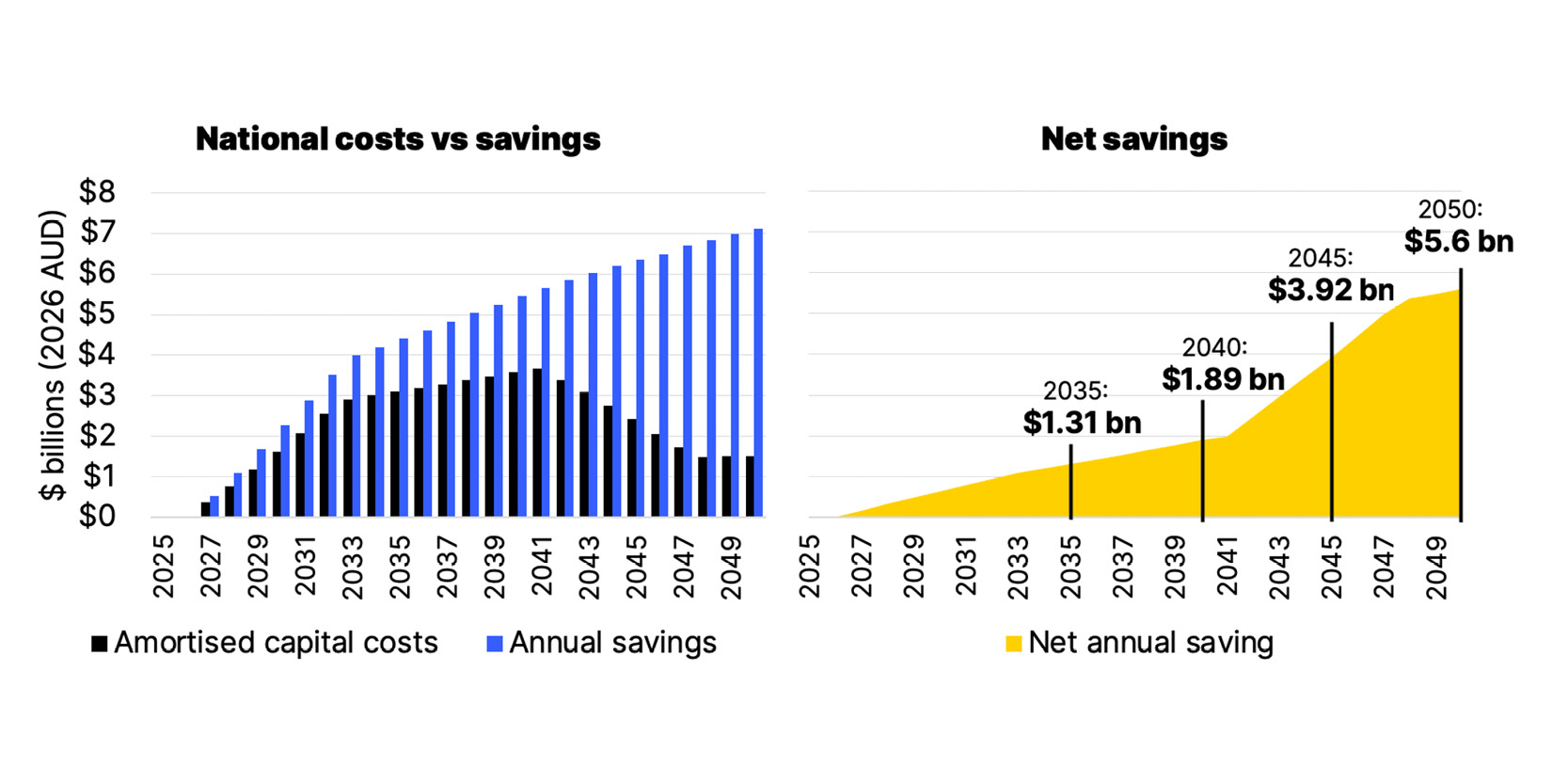
The long-term savings of the upgrades outweigh the capital costs. IEEFA calculates that upgrading rental properties starting from 2027 would deliver a net present value (NPV) of AU$24.8 billion to 2050 at a discount rate of 5%. NPVs were also consistently positive in each state and territory.
Upgrading rental properties would be cash-flow positive if the costs were amortised over a 15-year loan period at an interest rate equivalent to an investor home loan. This shows us that even if the costs of upgrades were passed on to renters, it is possible to ensure they benefit from day one.
Upgrading rental properties could also yield system-wide benefits. In most regions, the upgrades delivered a net reduction in average-day peak electricity demand in summer and winter, even if some renters increased their electricity consumption following the upgrades.
In Victoria, the electrification of a large stock of gas appliances could increase average-day peak demand in the long term. However, these increases were small relative to the reduction in gas demand that would be achieved, and could be addressed via additional measures such as increasing the stock of residential batteries.
Upgrading gas or inefficient electric appliances to efficient electric alternatives was a critical enabler behind these savings. The cost of upgrading rental properties is likely to be higher, and the benefits lower, if landlords continue to install new gas or inefficient electric appliances in rental properties.
In lieu of a state- or nation-wide approach to phase out the installation of these appliances, minimum energy-efficiency standards for rental properties should include a specific features-based provision to ensure new appliances in rental properties are efficient and electric.
Other upgrades – including thermal efficiency upgrades, rooftop solar and batteries – could be sequenced in a number of ways, and a flexible approach to implementing these upgrades makes sense. This could be via setting a benchmark standard under a relevant ratings scheme. However, it could also be implemented via a flexible, features-based approach.
While incentives and financing solutions alone are not effective, they could be key complements to the implementation of minimum energy-efficiency standards. Financial products should be provided to enable landlords to amortise the costs of their upgrades over a reasonable loan period, at an accessible interest rate. The Clean Energy Finance Corporation (CEFC)’s Household Energy Upgrades Fund could be adapted and expanded to fill this role.
States and territories should also consider adapting their existing incentive schemes to embed targeted rebates for landlords who upgrade their properties to meet minimum standards.
Finally, the federal government should consider introducing incentives to encourage rental property upgrades as part of ongoing tax reforms. This could include further restrictions on the eligibility for negative gearing, conditions on the ability to deduct appliance upgrade costs, or the introduction of instant asset write-offs or accelerated depreciation for home energy upgrades.
Summary of recommendations | |
1 | State and territory governments should aim to halve renters’ energy bills via minimum energy-efficiency standards. |
2 | Rental minimum energy-efficiency standards should mandate the installation of efficient electric appliances. |
3 | Rental minimum energy-efficiency standards should include a flexible component that can be met through a number of home energy upgrades. |
4 | The federal government should make discounted financing available for rental property upgrades via the CEFC. |
5 | State and territory governments should consider targeted transitional financial incentives to support landlords to upgrade their properties. |
6 | Federal tax incentives should be made conditional on properties meeting minimum standards. |

Related Content


